






There are topics that often only receive attention once they become a problem. Health is one of them.
As long as we are healthy, the healthcare system largely remains in the background of our daily lives. But when treatment is unavailable, a diagnosis is delayed, a waiting list becomes too long, or an illness forces someone out of the workforce, it quickly becomes clear that healthcare is not merely a matter of hospitals, doctors, and funding pools. It determines an individual’s quality of life, family stability, corporate productivity, and, ultimately, the economic strength of an entire nation.
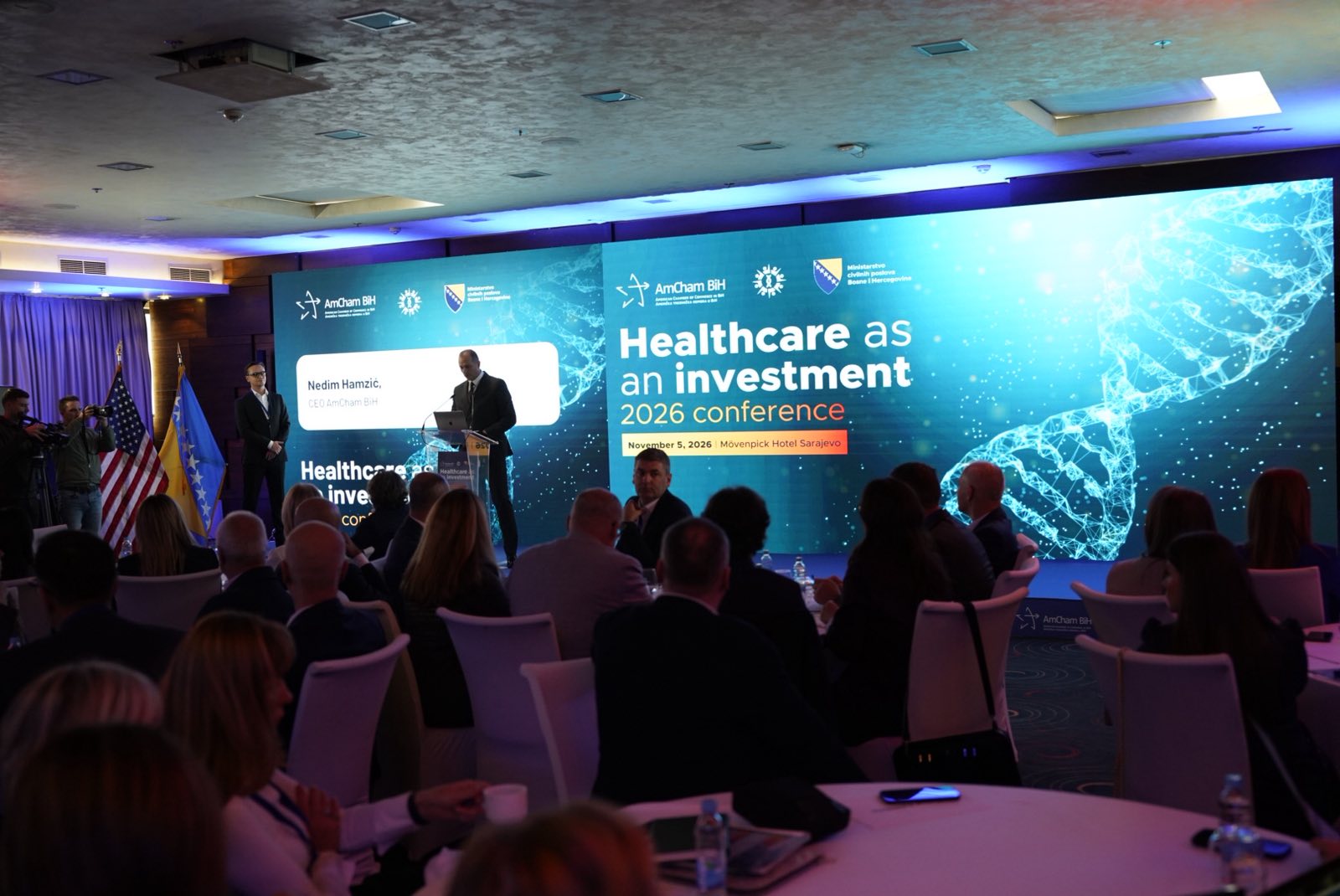
This year’s AmCham BiH conference, titled "Healthcare as an Investment," is built precisely upon this concept.
The conference was opened by Nedim Hamzić, Executive Director of AmCham BiH; Aurélie Valtat, Head of the European Integration Section at the EU Delegation to BiH; Joseph Rozenshtein, Economic Officer at the U.S. Embassy in BiH; and a representative from the Ministry of Civil Affairs of Bosnia and Herzegovina. During the opening session, a question was raised that should lie at the heart of any serious discussion on healthcare: what does it actually mean to invest in human health?
The answer is not simply "more money in the system."
Investment means better allocation of existing resources, earlier disease detection, higher-quality prevention, greater access to treatment, more efficient procedures, and a system that measures patient outcomes rather than just the volume of services provided.
One of the most compelling points to emerge from the conference is that more than 40 percent of diseases are preventable. And this is precisely where the entire logic of the conversation shifts.
If we can prevent a disease or detect it earlier, we are talking about much more than just a better health outcome. We are talking about an individual who remains healthy for longer, a parent who does not have to leave their job for prolonged medical treatment, an employee who can continue working, and a company that does not lose knowledge or productivity.
This is why healthcare has a direct and measurable economic impact.
A healthy population remains active in the labor market for longer, experiences fewer absences from work, demonstrates higher productivity, and places less strain on healthcare and social welfare funds. Conversely, a poor healthcare system very quickly becomes an economic burden borne by everyone: citizens, companies, and the state.
The panelists kept their focus on this point. The discussion explored what society gains when it invests in itself—in a timely manner and in the right way.
Ultimately, the primary criterion must be simple: what is best for the patient?
It is not about the number of procedures performed, the number of administrative steps completed, or the amount of budget line items spent. Rather, it is about whether an individual receives a diagnosis sooner, whether therapy is accessible, and whether the system increases their chances of living a longer, higher-quality life.
In this sense, the future of the healthcare system will not depend solely on new technologies or larger budgets. It will depend on our willingness to change how we measure its success.
Prevention must be given greater priority. Funding should be more closely linked to outcomes. Therapies should be evaluated based on the value they create for both the patient and the system. Furthermore, the public and private sectors must collaborate much more seriously in areas where they can offer superior solutions.
These are not questions for healthcare professionals alone. These are questions for finance ministers, employers, companies, insurance providers, funds, schools, and anyone considering what the labor market will look like in ten or twenty years.
Because an economy does not begin in a factory, a bank, or an office; it begins with an individual who is healthy enough to work there.
Therefore, perhaps the most important message of this year’s conference is also the simplest: investment in healthcare is not merely a cost we must bear. It is an investment without which long-term economic development is impossible.
We extend our special thanks to all the panelists, whose contributions steered the discussion toward what matters most—better outcomes for patients—as well as to the companies that made this gathering possible: Medtronic, Sandoz, Roche d.o.o. – Roche Ltd., Novo Nordisk, EHS, IQVIA, medIT, MSD, and Hemofarm – EUNOVA.