






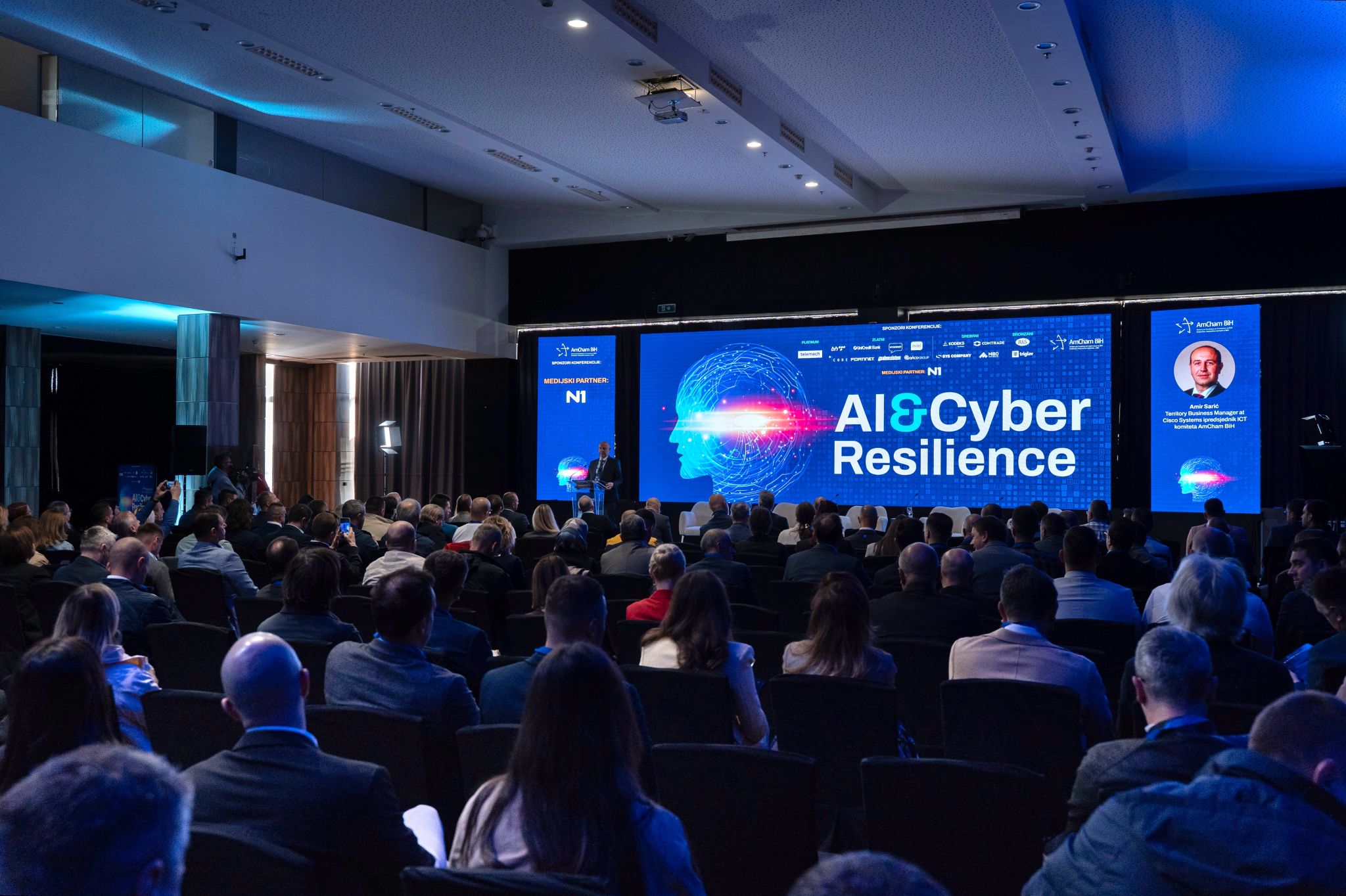
More than 200 representatives from companies, institutions, the IT sector, and the business community gathered in Sarajevo on October 6 for the "AI & Cyber Resilience" conference, organized by the American Chamber of Commerce in BiH (AmCham BiH). The conference focused on the impact of artificial intelligence on cybersecurity, emerging threats, regulatory requirements, and the knowledge and competencies needed for a secure digital future.
The conference opened with remarks from Sarah Bedenbaugh, Economic and Commercial Officer at the U.S. Embassy in Sarajevo, and Amir Sarić, Territory Business Manager at Cisco Systems and Chair of the AmCham BiH ICT Committee. The opening session highlighted the importance of collaboration among companies, institutions, and the expert community in strengthening cybersecurity, building reliable digital infrastructure, and ensuring the responsible application of artificial intelligence.


The program began with keynote presentations offering diverse perspectives on the development of AI technology and cybersecurity. Jovan Bogičević, Cybersecurity Lead for Serbia, Bosnia and Herzegovina, and Montenegro at EY, discussed the capabilities and limitations of AI models in cyber defense, as well as new offensive scenarios.

Yana Humen, Senior Manager for Government and Regulatory Affairs at IBM, presented the evolution of European cyber policy and key elements of the Cyber Resilience Act, highlighting their significance as guidelines for developing a cybersecurity framework in Bosnia and Herzegovina. Srđan Babić, Chief of Information Security at Cyber Gate, spoke about the knowledge and competencies that organizations and the workforce will require in the era of artificial intelligence.


Nedim Hamzić, Executive Director of AmCham BiH, highlighted that the development of artificial intelligence brings significant opportunities but simultaneously alters the nature of cyber threats, necessitating a new approach to security. "Artificial intelligence is transforming the way companies operate, as well as the way cyber threats emerge. Therefore, it is essential to build resilience, develop expertise, and view security as an integral part of business decision-making," Hamzić stated.
Two panel discussions addressed key aspects of AI and cybersecurity—ranging from the development of regulatory frameworks, European standards, and the roles of the public and private sectors in strengthening cyber resilience in BiH, to the development of new skills and competencies, the alignment of education with industry needs, and the impact of artificial intelligence on the future of work.


A special highlight of the conference was BH Telecom’s presentation, "From Strategy to Results: The Application of Generative AI at BH Telecom," which offered a concrete example of AI technology implementation in a business environment.
Expert presentations by company representatives focused on practical cybersecurity challenges, including enterprise network security, the operations of Security Operations Centers (SOCs), cyber risk management, data protection, and the security of AI systems.
This year's "AI & Cyber Resilience" conference confirmed that while the development of artificial intelligence offers significant opportunities, it also demands a new level of responsibility, knowledge, and preparedness regarding cyber risks. Consequently, strengthening cyber resilience is not solely the task of the IT sector but a shared responsibility among companies, institutions, and the professional community.
The conference was held with the support of sponsors Telemach BH, BH Telecom, UniCredit Bank d.d. Mostar, HT Eronet, m, CORE, ALEM Sistem, Fortinet, Artco Group, Comtrade System Integration, Kodeks, MIBO Komunikacije, SYS Company, R&S, and Triglav Osiguranje, while N1 served as the media partner.