





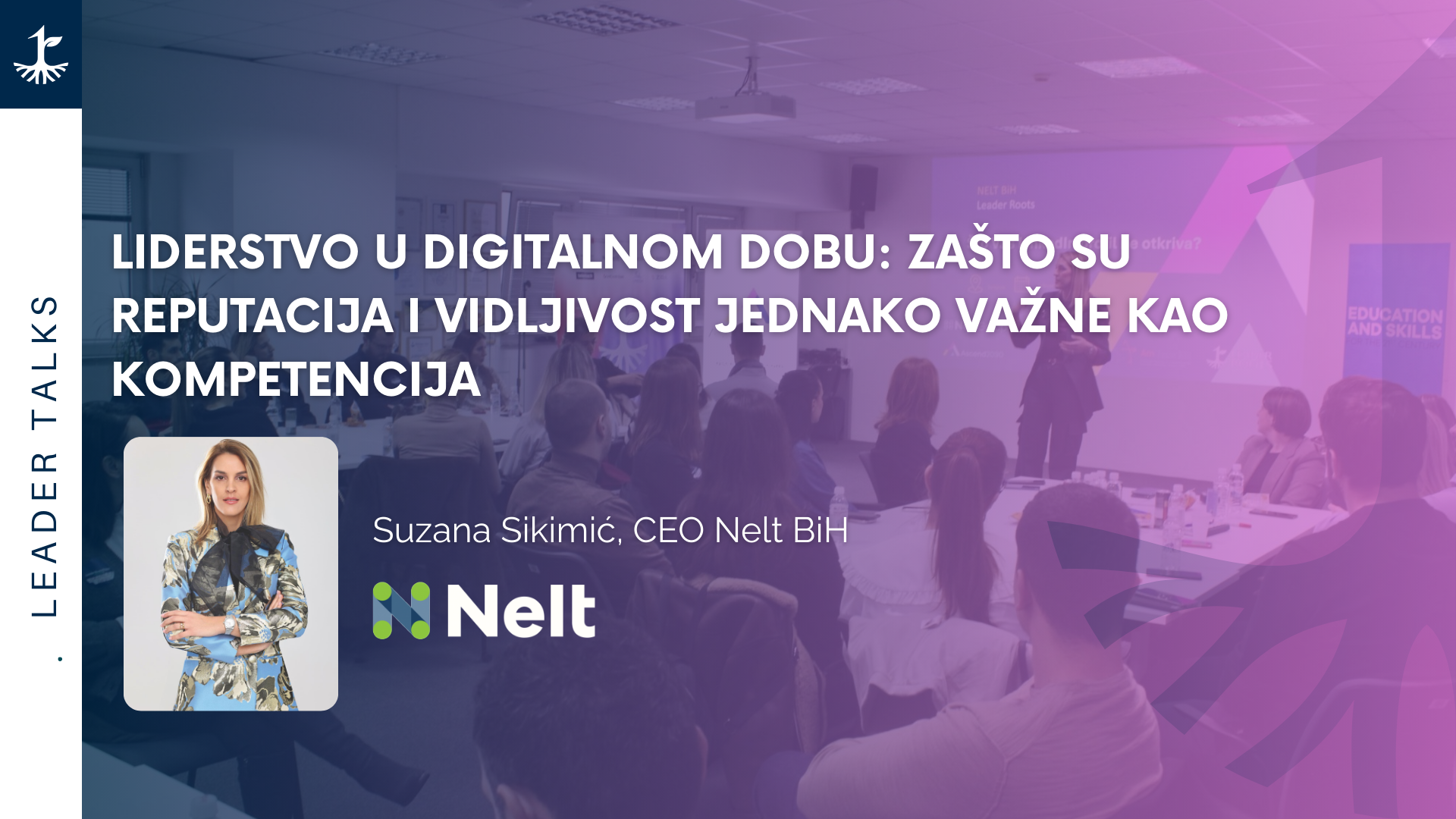
In our conversation with Suzana Sikimić, CEO of NELT BiH, we focused on how modern organizations build the connection between competence, reputation, and employee visibility, as well as the role of digital identity in leadership development.
Speaking about organizational culture, Sikimić emphasizes that these three dimensions cannot be treated separately.
“I believe that competence, reputation, and employee visibility should grow together,” she notes. She explains that the foundation lies in continuous development: “We build competencies through continuous learning, knowledge sharing, and clear standards of professionalism.” Reputation, she adds, is a result of consistency: “Reputation is built through consistency, accountability, and the way we, as a team, deliver results to partners and the market.” Visibility, however, requires intentional support: “We encourage employee visibility by recognizing their achievements, giving them space to share their experiences, and actively participate in professional communities.” This is where she sees the role of leadership: “As leaders, it is our responsibility to create an environment where expertise is visible, recognized, and developed.”
The discussion on digital presence introduced an additional layer, particularly in the context of first impressions.
“For leaders today, it is extremely important to understand how their professional identity appears beyond direct interactions,” she explains, adding that perception is often formed in advance: “The first impression is increasingly shaped through the digital footprint.” She sees online communication as an extension of leadership: “The way we communicate online becomes an extension of our leadership and the values we represent.” This is why alignment is critical: “When the digital identity is aligned with the way we actually lead and the values we live within the company, it becomes a powerful tool for building trust.” Ultimately, she emphasizes that visibility is not an end in itself: “Visibility is not a goal on its own, but an opportunity to contribute to the broader business environment through professional integrity and knowledge.”
A particularly interesting part of the discussion focused on the impact of digital visibility within organizations themselves.
“Digital visibility today can have a significant impact on career development within the company, not only on the job market,” Sikimić points out. She explains that clearly communicating one’s work creates opportunities: “When employees clearly communicate their knowledge, projects, and professional interests, they become more visible within the organization as well.” This often leads to new responsibilities: “It opens the door to new responsibilities, involvement in important projects, or cross-functional collaboration.” However, she stresses that authenticity remains key: “It is important that this visibility is authentic and grounded in real results and contributions to the team.”
When discussing LinkedIn, Sikimić takes a balanced view.
“LinkedIn is certainly one of the fundamental tools for professional visibility today,” she says, while immediately broadening the perspective: “However, for leaders, it is increasingly important to think beyond the platform itself.” She does not see reputation as purely digital: “Reputation and influence are built through the quality of work, decision-making, relationships with people, and contributions to the professional community.” Digital channels play a role, but a limited one: “Platforms like LinkedIn can help make that contribution more visible, but they are only one part of a much bigger picture.” She also highlights the importance of other forms of engagement: “Participating in expert discussions, conferences, mentoring, or knowledge exchange often has an equally strong impact on building professional credibility.”
Finally, she shared advice for young managers looking to develop their careers.
“The focus should always be on building real expertise – through experience, results, and continuous learning,” she emphasizes. At the same time, she adds that this alone is not enough: “It is equally important to learn how to clearly present that knowledge and experience to others.” She sees knowledge sharing as a responsibility: “Sharing professional insights and lessons learned can be a valuable way to contribute to the broader professional community.” Authenticity remains central: “Do not communicate more than what you can truly stand behind with your work.” Ultimately, she highlights the importance of balance: “When expertise and the way we communicate it are in balance, professional identity becomes credible and recognizable.”